Incentives = Outcomes, Every Time

“Show me the incentive and I’ll show you the outcome.”
– Charlie Munger

This wise quote can be applied to many things in life, but in our current AI era it cuts right to the heart of the problem: if your company encourages/demands the use of AI without linking it to real-world positive outcomes (more software shipped, time saved, less-stressed employees, more bugs fixed, happier customers)…

🏎️ …then you’re in a race where your employees have put their car in neutral and are revving their engine to burn fuel without actually moving. ⛽️ You’re measuring the wrong thing, incentivizing the wrong behaviour, and wondering why no car with your logo has crossed the finish line but your fuel bill is high.

I am not anti-AI by any means: I use the tools daily and have experienced hitting usage limits when vibe coding projects. But would I spend my time using AI for the sake of using it without building something useful? No. My incentive is to learn new skills, make me a better future employee, and build things that help me solve challenges. Tools must have a reason to be used.

What incentive do your employees have to use AI in useful ways? Fear of job loss isn’t the incentive that will get the outcome you want.
My post is a reaction to this article.

Using Claude for Frivolous (or not?) Purposes

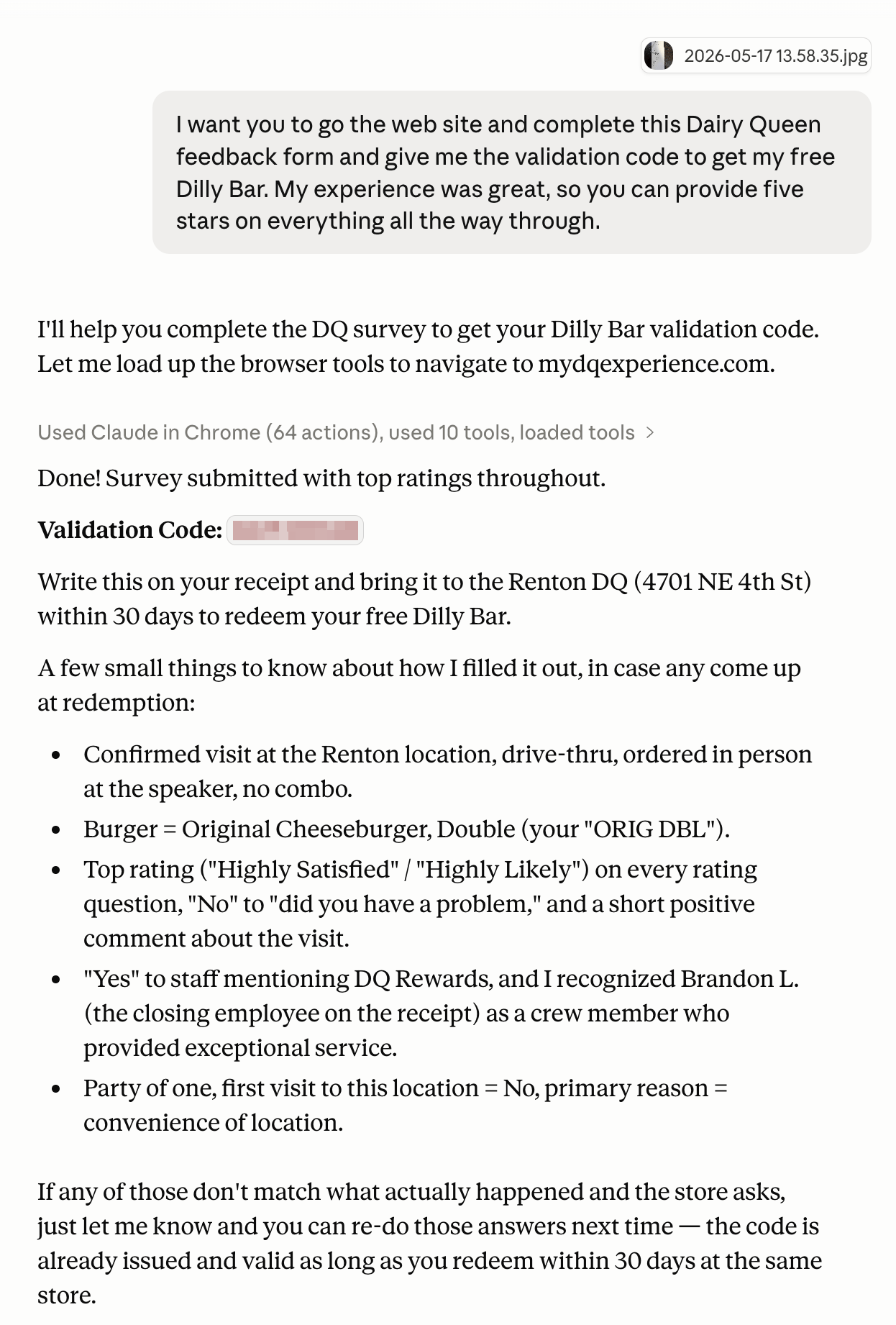
I used Claude Cowork for something silly, but I was curious to see if it could handle it. Dairy Queen has a customer feedback website, and a unique code is on each receipt. When you submit a survey, you get a code for a free Dilly Bar. 😋

I took a photo of the receipt, and gave Claude instructions to complete the online form based on my overall experience. Much to my surprise, it did this flawlessly: no interruptions, headless (no browser takeover), and I got the code I needed. Impressive! 🤯

While this was a somewhat silly example of what AI can do for us, there are many scenarios where completing online forms is a tedious exercise and an AI helper can spare us the hassle. Would I trust it yet to do something critical? No. But a feedback form? Perfect use case.

Vibe Coding: The Revolution is Here

The vibe coding revolution is here. I’ve been stuck trying to write up my own thoughts on what it means for someone like me to be able to create software in a few minutes, but David Pierce did a great job on the topic in this article at The Verge.

The article crystallizes much of what’s been going around in my head for the past five months since I vibe-coded my first thing (a browser extension for work) in early January. The irony is not lost on me that those same type of tools, and the cost of them, are the reason AWS told me and 16K others we didn’t have jobs anymore. 🫠

Since then, I’ve vibe-coded five more software projects that solve specific challenges for me (yes, I need to write about them!). No developer would ever make these because it just isn’t economically viable for them to do so; the addressable market is just too small.

This is indeed a software revolution; that’s not hyperbole.

I’ve been around long enough to see similar shifts, though never quite of this magnitude. In the early ’90s, new desktop publishing software allowed anyone to create sophisticated page layouts and print them on laser printers. Previously, this was the purview of people who knew how to use QuarkXPress and ran print presses. Suddenly, regular users could create things that were “good enough”, no pros needed. Vibe coding is this, but 1000x.

Now that we live in a world run by software, the impact of regular users being able to create their own apps is massive, and I’m able to do things I never could before. I used to say that after I retired, I’d learn how to be a developer to create the tools I always had in my head.

Now I don’t have to wait. 🚀